

Samsung Galaxy A7 Triple Cameras Explained: How Do They Work?

The new Galaxy A7 (2018), which was announced earlier today, holds the distinction of beingness the first Samsung smartphone to characteristic triple rear cameras. It is quite surprising for Samsung to launch a mid-range smartphone which packs such a distinctive feature that has then far been sectional to flagship devices such as Huawei'due south P20 Pro, or the Oppo R17 Pro.
Just are the Galaxy A7's triple rear cameras only a marketing ploy to revive the sales of Samsung'south Milky way A-serial devices? Well, we can't be sure. Merely if you are wondering how a triple rear camera can improve the imaging output, then let's get straight to the hardware and see how information technology works.
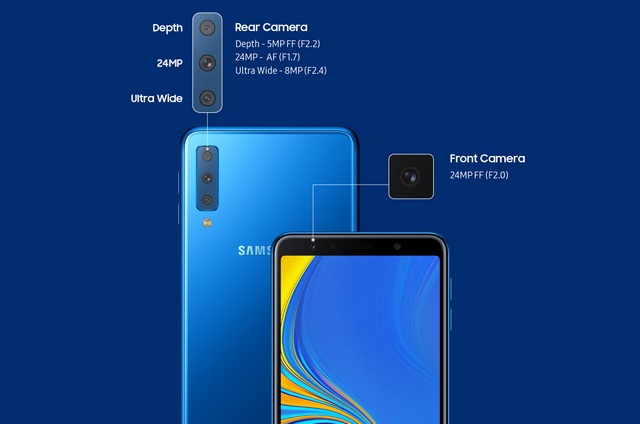
Master Camera
The Galaxy A7'south imaging hardware has a24MP RGB sensor with a F/1.seven aperture, which sits in the heart of the vertical stack of lenses. Above information technology is a 5MP depth sensor with F/2.2 aperture, while an8MP wide-bending lens with F/2.4 aperture and a 120-degree field of view sits at the bottom. On the other manus, Huawei's P20 Pro packs a 40MP RGB sensor, an 8MP telephoto lens and a 20MP monochrome lens.
Coming to the applied applications of these sensors, the Milky way A7'southward 24MP RGB sensor acts every bit the primary camera and is too capable of pixel-binning (combining iv pixels into one) for extracting more detail from the scene in the terminal image, particularly in low-light conditions.
AI Scene Optimizer
The main camera gets the Scene Optimizer feature which was first seen in the Galaxy Note ix. This allows the camera to apply AI algorithms to automatically recognise scenes and tweak camera settings such as the white rest, exposure, dissimilarity and effulgence values to match the scene. Currently, the feature can identify 19 scenes including food, landscapes, street view, night scene, animals and embankment amongst others.
Scene Optimizer really makes a difference when it comes to overall image quality as nosotros have seen in our review of the characteristic in the Notation 9.
Secondary Camera
The 5MP (F/2.2) sensor sits on the top of the stack, and is used to capture depth data in the scene. The camera calculates the distance betwixt different objects in its view, so that information technology can carve up the foreground and background and create a ameliorate depth of field effect for bokeh shots. Patently, the SoC helps in depth calculation and the blur effect is applied at the edges to make the object stand out. Samsung could also permit users adjust the blur intensity, as is seen in its flagships.
You can argue that a monochrome sensor is ameliorate for depth sensing because it tin capture more lite, but secondary monochrome lenses with a high resolution are more expensive to procure, which is why they are usually seen on high-finish devices.
Ultra-Wide Camera
Finally, in that location is an 8MP (F/2.4) ultra-wide sensor with a 120-degree field of view which is well-nigh the aforementioned every bit the regular FOV of human being eyes. Then, on newspaper, the Galaxy A7'southward 8MP ultra-broad lens will let you capture a shot of everything that is in your view.
The wide-bending lens comes into play when you want to capture a group shot or a scenery and desire the epitome to be as wide as possible to go the whole scene. The f/two.four lens has become a mainstay on upper mid-range devices with dual photographic camera setups when it comes to capturing wide-angle shots, and will serve the Galaxy A7 users just fine.
Then there you take information technology. With everything Samsung has revealed and so far, the Milky way A7 might actually take a actually great camera. Plainly, there's a lot of testing to be washed. Nosotros don't even have official camera samples yet, so clearly Samsung is just announcing the specs at this fourth dimension. Stay tuned to find out more virtually this exciting new Samsung Milky way A series phone.

Source: https://beebom.com/samsung-galaxy-a7-triple-cameras-hardware/
Posted by: riversdrinto.blogspot.com
0 Response to "Samsung Galaxy A7 Triple Cameras Explained: How Do They Work?"
Post a Comment